Rolling Twins: Music Ball Rush
- 4.6
- Rating
- 50.00M
- Installs
- Free
- Price

 Analysis by App-foxy
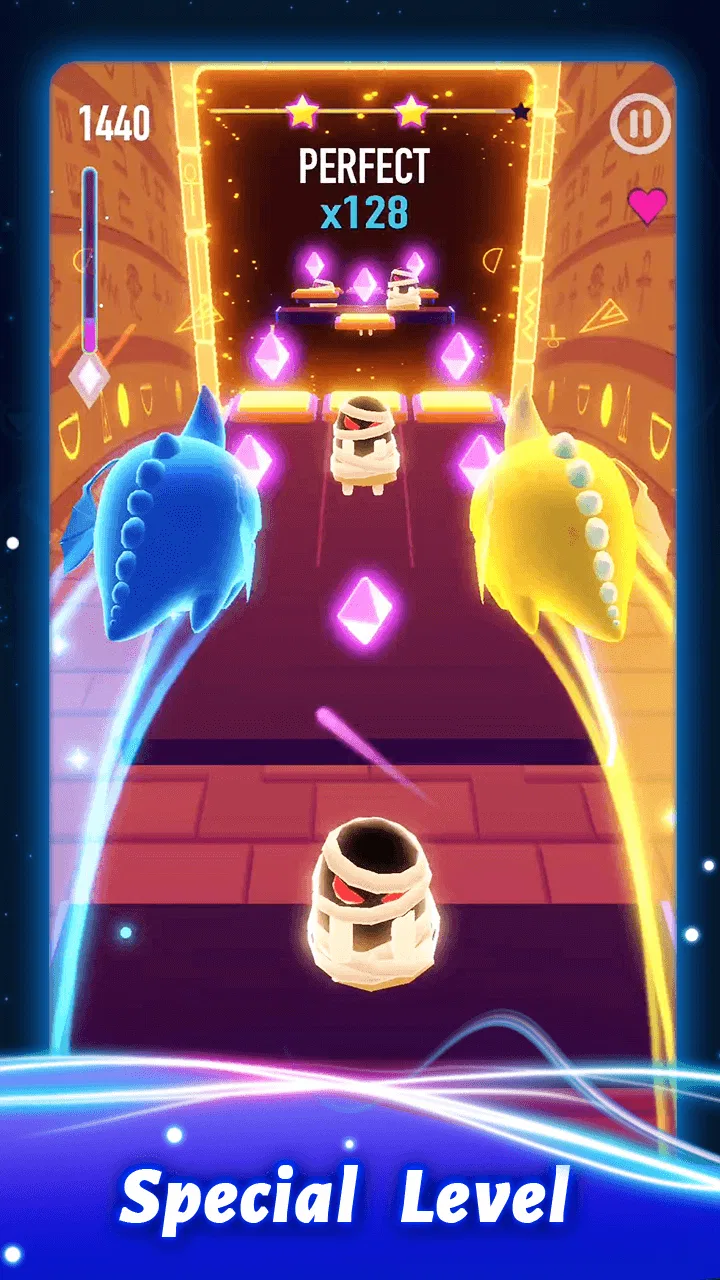
I approached Rolling Twins: Music Ball Rush expecting a quick music game, but its appeal is more specific than that. It turns familiar piano-tile timing into a rolling-ball challenge, with the music acting less like background decoration and more like the rhythm guide for every move. That combination gives it an easy starting point: you can understand the basic idea almost immediately, yet the timing still asks for attention once the pace rises.
This is a free music game from Cobby Labs, rated for Everyone. It has reached over 50 million installs and holds a 4.6 average from around 74 thousand ratings, which makes its broad appeal easy to understand. I would describe it as a casual game first and a serious rhythm test second. You can play for a short break, but you can also find yourself replaying a section because one missed beat feels fixable.
Why the rolling format changes a familiar music game
The central capability is the blend of rolling-ball movement and piano-tile-style rhythm timing. Instead of simply tapping a line of notes, I have to pay attention to the ball’s position while matching the music. That extra visual layer changes the kind of concentration the game demands. My hands are responding to rhythm, but my eyes are also tracking a moving path and anticipating what comes next.
You May Also Like

 AccuWeather: Weather Radar
AccuWeather Review: A Quick, Clear Forecast for Everyday Decisions
For everyday plans, the best forecast is the one you can understand quickly. AccuWeather makes rain timing, radar, and local conditions easy to act on, with a few trade-offs.

 Hill Climb Racing
Why Hill Climb Racing Still Turns Crashes Into One More Run
A tiny car, a bumpy hill and one more upgrade: Hill Climb Racing keeps resurfacing because its simple chaos makes every near-miss feel personal.

 AliExpress - Shopping App
AliExpress Makes Global Shopping Feel Personal, but Shoppers Bear the Risk
AliExpress turns a global marketplace into a pocket-sized discovery engine. Its reach is useful, its shopping loop compelling, and its trade-offs easy to miss.

 Lords Mobile: Kingdom Wars
Lords Mobile Is a Kingdom-Building Routine, Not a Quick Match
A case-by-case verdict on the building, battles, device demands, and social commitments that make Lords Mobile rewarding for some players and exhausting for others.

 PDF Scanner app - TapScanner
TapScanner Makes Paperwork Easier to Capture, Check, and Share
TapScanner makes scanning with a phone feel less like a rescue operation and more like a dependable step in getting work done. Its capture tools are useful, though not flawless.

 Block Blast!
 Shows How Much a Puzzle Game Can Leave Out
A quiet grid game shows why puzzle players increasingly value instant clarity, repeatable skill and low-pressure play—and where the genre still needs to catch up.
More From Our News Desk
View All News


That distinction matters because the game does not feel like a standard piano simulator with a different skin. The rolling presentation creates a stronger sense of motion. A successful sequence feels like guiding the ball through the song rather than merely pressing buttons in time. When I lose the rhythm, the mistake is noticeable both musically and visually, which makes the result more satisfying when I recover.
The K-pop influence also helps give the experience a recognizable identity alongside its broader music-game format. I would not install it expecting a full music library or a replacement for a dedicated rhythm platform. Its strength is the compact combination of familiar song-game cues, ball movement, and quick attempts. It is designed to make starting easy, not to turn music practice into a formal discipline.
What the first few sessions feel like
The opening experience is approachable because the basic goal is clear. I do not need a long explanation to understand that timing and movement have to work together. That makes it suitable for someone who normally avoids rhythm games because they seem complicated. The visual design communicates the task quickly, and the music gives me a natural reference point even before I become comfortable with the controls.
After that first impression, the important question becomes whether the timing remains interesting. For me, it does when I treat each attempt as a short exercise in concentration rather than as a passive music video. The game rewards listening, but it also rewards looking ahead. Focusing only on the current beat is not always enough; the rolling path encourages me to prepare for the next change instead of reacting at the last possible moment.
That is one of the less obvious strengths of this format. It trains a small habit of anticipation. I begin by reacting to each note, then gradually start reading the upcoming movement as a phrase. This makes repeated attempts feel more useful than simply trying to move faster. If a section causes trouble, I can often improve by changing where I look, not only by tapping more quickly.
How I use the rhythm without letting it overwhelm the visuals
My most reliable approach is to let the music establish the pulse while using the screen to confirm the route. When I stare too closely at the ball, I tend to respond late because I am waiting for each event to happen. When I listen for the beat and keep my attention slightly ahead, the movement becomes easier to predict. That balance is important, especially for players who are used to piano-tile games where the next input is the only major concern.
A useful everyday routine is to give a difficult section two different kinds of attempts. In the first, I concentrate on the sound and accept that I may fail. In the second, I watch the path more deliberately and use the remembered rhythm to reduce hesitation. This prevents the common mistake of repeating the same failed approach over and over. The game is more enjoyable when each replay has a small purpose.
I also found that short sessions suit the design better than forcing a long play period. Because the main action depends on timing, tired attention can make a familiar passage feel unfair even when the problem is simply concentration. Playing for a few minutes, stepping away, and returning later can be more effective than continuing while frustrated. That is practical advice for a free casual game, but it also reveals the trade-off: the experience depends heavily on the player’s focus at that moment.
How it works in a real daily situation
The best scenario for me is a brief waiting period when I want something more engaging than scrolling but do not want to begin a large game. A few minutes before an appointment, during a commute break, or while waiting for a friend, the rolling format gives me an immediate task. I can start without preparing a strategy, listen for the rhythm, and stop without feeling that I have abandoned a complicated storyline or a long mission.
It also works well as a shared discovery game for families because the age rating is Everyone and the basic idea is easy to demonstrate. A younger player can understand the visual goal, while an older player may enjoy trying to improve timing. I would still expect skill differences to appear quickly. Someone with strong rhythm-game experience may find the early learning curve gentle, whereas a newcomer can treat the same stages as a useful introduction to timing-based play.
One particularly practical use is as a concentration reset. I sometimes prefer a focused two-minute challenge to an endless feed because the game gives my attention a clear target. The music supplies structure, and the rolling motion keeps the eyes involved. That does not make it a productivity tool, and I would not claim it improves musical ability in a formal sense. Its real value is simpler: it offers a contained activity that asks me to be present for a short time.
The game is less suitable when I want a relaxed listening experience. The music is connected to performance, so I cannot fully enjoy it as background audio while doing something else. If I am distracted, the rolling sequence exposes that quickly. Players looking for deep composition tools, free-form music creation, or a large competitive rhythm ecosystem should choose a different kind of app. This one is about guided interaction, not musical control.
Small habits that make the game feel fairer
I get better results when I hold the device steadily and avoid playing while walking. That sounds obvious, but the rolling visual cues make small changes in attention more disruptive than they would be in a simple tap game. A stable position helps me distinguish an actual timing mistake from a moment when I simply looked away.
I also recommend lowering the ambition of a session. Instead of deciding that I must complete everything perfectly, I focus on identifying the exact moment where my timing breaks down. Sometimes the issue is that I am tapping early because I am anticipating the beat. At other times, I am watching the ball instead of the route ahead. Naming the problem turns a vague failure into something I can correct.
Another useful trade-off is deciding whether to prioritize the music or the movement. On a first attempt, I listen more closely so the rhythm becomes familiar. On a later attempt, I let the visual route lead while the song acts as a timing check. Switching between those priorities is more effective than treating every replay identically, and it is one reason the simple concept has more depth than the short description suggests.
Where the experience can lose momentum
The same accessibility that makes the game welcoming can limit it for experienced rhythm players. If I want demanding precision from the beginning, the early experience may feel too gentle. The rolling presentation adds character, but it does not automatically create the complexity of a dedicated rhythm title with extensive control options or a highly specialized competitive structure.
There is also a natural risk of repetition. The core loop is deliberately focused: follow the movement, match the musical timing, and try again when the sequence goes wrong. That focus is excellent for quick sessions, but players who need constant mechanical variety may tire of it sooner. I think the game works best when approached as a collection of short concentration challenges rather than as a single large adventure.
Its free price makes trying it easy, but free access does not change the basic question of fit. If I dislike replaying a section to improve timing, I am unlikely to enjoy the main appeal for long. Likewise, anyone wanting a game that can be played with minimal attention should look elsewhere. The music is not merely decoration, and the ball is not an automatic tour through a song; both are part of the task.
The current version is 0.3.0, and it runs on Android six point zero or later. Those details make it accessible to many Android users, although anyone using an older device should check compatibility before planning around it. I would also keep expectations realistic about the platform: this review concerns the Android game experience, so people choosing between mobile platforms should confirm that the version available to them matches what they want before downloading.
How it compares with ordinary alternatives
Compared with a conventional piano-tile game, this title gives my eyes more to do. Piano-tile play often centers on selecting the correct falling area, while the rolling-ball approach adds direction and movement to the timing problem. That makes it feel more animated and physical, though it can also make mistakes harder to diagnose because a miss may come from visual tracking, rhythm, or both.
Compared with a music-listening app, it is obviously more demanding but also more memorable. I am not just hearing a track; I am using its pulse to guide an action. Compared with a full rhythm-game alternative, it is easier to pick up and better suited to short breaks, but it may not satisfy someone searching for extensive customization or a long-term competitive challenge.
That middle position is the reason I would recommend it selectively. It is more interactive than passive music entertainment and less intimidating than a specialist rhythm game. The rolling format is not a minor visual change; it determines how I pay attention. If that combination sounds appealing, the game has a clear reason to exist. If I only want songs or only want deep mechanics, another category will serve me better.
Who gets the most from Rolling Twins
I think the strongest audience is made up of casual players who enjoy music, quick retries, and visible movement. It is especially suitable for someone who wants to try a rhythm game without learning a complicated control scheme. The Everyone rating also makes it a reasonable option to introduce the basic idea of timing-based play in a family setting, provided each player understands that improvement comes from concentration rather than random tapping.
It can also suit fans of K-pop-flavored mobile games who want something lighter than a large collection-based experience. The game’s identity comes from combining music cues with the ball’s journey, so the best match is a player who enjoys the feeling of synchronizing action and sound. I would recommend using headphones when practical, not because the game requires a special setup, but because the rhythm is easier to follow when surrounding noise is less distracting.
I would skip it if my priority were a deep musical instrument simulation, extensive song management, or a game that rewards long strategic planning. I would also skip it if I find repeated timing attempts irritating. The title is honest about its central pleasure: improving through attention and replay. That can be satisfying, but it is not the right structure for every player.
For me, the final verdict is positive with a clear qualification. The rolling-ball rhythm system is the feature that earns the download, because it gives a familiar music-game idea a more visual and anticipatory feel. It is free, easy to approach, and proven popular with over 50 million installs, yet its value depends on whether I want active listening rather than passive entertainment.
Rolling Twins: Music Ball Rush is at its best as a compact focus game: start it during a spare moment, follow the beat, learn where attention slips, and try again with a better plan. Cobby Labs has kept the concept approachable without removing the small satisfaction of mastery. I would recommend it to casual rhythm fans and newcomers, while pointing committed music-game players toward a deeper alternative if they need more complexity than this focused rolling format provides.
FAQs for Rolling Twins: Music Ball Rush
01What is Rolling Twins: Music Ball Rush?
Rolling Twins: Music Ball Rush is a dynamic music rhythm game where players guide a ball along a track, hitting beats in time with popular songs. The game combines fast-paced action with an engaging soundtrack, offering a visually stunning experience with vibrant graphics and smooth controls.
02How do you play Rolling Twins: Music Ball Rush?
In Rolling Twins: Music Ball Rush, players swipe left and right to control the ball's movement, aligning it with the rhythm of the music. The goal is to hit as many beats as possible while avoiding obstacles. The game requires quick reflexes and a good sense of rhythm to achieve high scores.
03What types of songs are available in the game?
Rolling Twins: Music Ball Rush features a diverse selection of songs across various genres, including pop, rock, and electronic music. The game regularly updates its playlist, ensuring players have access to the latest hits. This variety keeps the gameplay fresh and engaging for music lovers of all tastes.
04Are there in-app purchases in Rolling Twins: Music Ball Rush?
Yes, Rolling Twins: Music Ball Rush offers in-app purchases. Players can buy additional songs, cosmetic upgrades, or power-ups to enhance their gameplay experience. While the game is free to download, these purchases can help players progress faster or customize their experience more fully.
05Is Rolling Twins: Music Ball Rush suitable for all ages?
Rolling Twins: Music Ball Rush is designed to be accessible to players of all ages. Its simple controls and engaging gameplay make it suitable for children and adults alike. However, parents should be aware of the in-app purchases and may want to manage settings if younger children are playing.
Pros
- Intuitive controls make it easy to play.
- Vibrant graphics enhance user experience.
- Wide range of popular music tracks.
- Regular updates with new levels.
- Offline mode available for play anywhere.
Cons
- Ads can interrupt gameplay frequently.
- Limited customization options.
- Some tracks require in-app purchases.
- Occasional lag on older devices.
- No multiplayer mode for added challenge.

Rolling Twins: Music Ball Rush
Gallery